Catastrophe Ladder
Key ideas
Skill summary
Three quick reminders before you start.
Overview
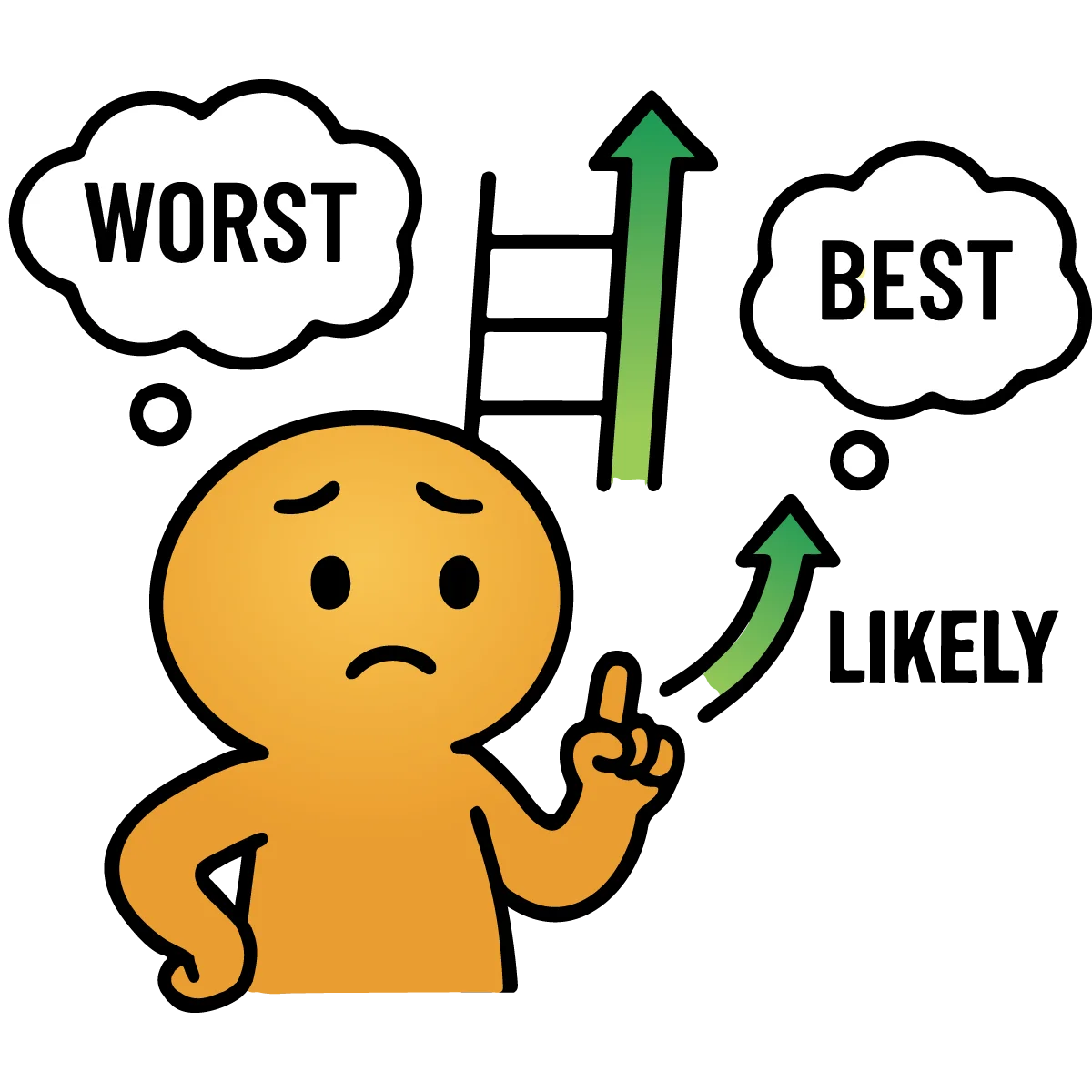
The Catastrophe Ladder is a way to sort through the noise when your brain starts racing with 'what-if' thoughts. It helps you take a step back and look at a situation from different angles instead of just focusing on the scariest one. By laying out the possibilities, you can feel more in control of your reactions and behaviour during stressful times.
How Your Brain Works
Your brain uses two main parts to manage your feelings and your ability to think clearly.
The Guard Dog
The alarm system. Reacts to stress with fight-or-flight responses.
The Wise Owl
Logic and calm decision-making, best accessed when the alarm quiets down.
The Guard Dog's Alarm
- The Guard Dog, or the amygdala, is the part of your brain that acts like a security system. Its job is to keep you safe by spotting potential threats in your environment.
- When you feel a surge of anxiety, the Guard Dog starts barking. It floods your system with stress signals, making your heart race and your breathing shallow.
- Because it is focused on survival, the Guard Dog often exaggerates the danger. It makes you believe that the absolute worst thing that could happen is actually a certainty. This is what we call a false alarm.
The Wise Owl's Perspective
- The Wise Owl, or the prefrontal cortex, is the logical and rational centre of your brain. It is responsible for making decisions and looking at the facts of a situation.
- When you use the Catastrophe Ladder, you are giving the Wise Owl the microphone. By writing down your thoughts, you create some space between yourself and your feelings.
- This allows the Wise Owl to look at the Guard Dog's alarm and ask, "Is this really likely?" This process helps calm the alarm system and brings your brain back into balance.
How to Use This Skill
Imagine you are teaching your Guard Dog how to read a map so it stops barking at every shadow it sees in the backyard.
Write the Worst-Case Scenario
Write down the absolute scariest thing you think might happen, like failing a big test and never graduating.
Write the Likely Outcome
Write down what usually happens, like maybe you struggle with a few questions but pass with a decent grade.
Write the Best-Case Scenario
Imagine yourself getting an A on that test and feeling super proud of all your hard work.
Real-Life Example
Social Stress at the Party
The Social Situation
Getting invited to a party when you have not been out in a long time and feel nervous about it.
The Guard Dog Thought
I am going to have a total meltdown, everyone will laugh at me, and I will be a social outcast forever.
The Breakdown
- Worst Case: The teen writes they will have a panic attack and everyone will judge them.
- Likely Case: They realize they will probably feel nervous for fifteen minutes, talk to a few friends, and stay for an hour.
- Best Case: They might actually have a great time and make a new friend.
By seeing the Likely outcome, the Wise Owl helps the Guard Dog calm down so the teen can attend the party and use their skills.
Practice Tips
Try these ideas to make the ladder even more effective when you feel stressed or overwhelmed.
- Write it out
Getting your thoughts onto paper helps the Wise Owl take control much better than just thinking about it.
- Focus on 'Likely'
Use the likely scenario to build your plan. It helps you feel prepared for what will actually happen.
- The Review
After the event, check back. Was the likely outcome right? This teaches your brain to trust your logic over time.
Pro Tip
Why It Works
It helps you see the middle ground when your thoughts feel extreme and scary.
This skill can support your well-being because:
- Calming System
Realistic thinking signals to your body that you are safe, which activates your body's natural calming system.
- Confidence Builder
By predicting likely outcomes and seeing them come true, you build confidence in your ability to handle things.
References
Research-based evidence supporting this skill
- This tool is based on standard ways to help people rethink their fears, though the specific name is informal.
- The Cantril Ladder as a Measure of Well-Being and Life Satisfaction. (2024). PubMed Central.
- The Cantril Ladder as a Measure of Well-Being and Life Satisfaction. (2024). Springer Medizin.
- SAMHSA. (n.d.). Disaster Behavioral Health Interventions Inventory.
- Trajectory of adjustment difficulties following disaster. (2024). BJPsych Open.
- The Mental Health Impacts of Successive Disasters. (2024). National Institutes of Health.