Label the Pattern
Key ideas
Skill summary
Three quick reminders before you start.
Overview
Ever feel like your brain is stuck on a loop of stressful thoughts? Labelling the pattern is a simple way to pause those thoughts before they take over. It is about noticing when your mind starts playing tricks on you, like assuming you know what others are thinking or expecting the absolute worst.
By giving these patterns a specific name, you create a little bit of space between yourself and the thought. This helps you stay in control of your reactions instead of just feeling swept away by your emotions.
How Your Brain Works
Your brain uses two main parts to manage your feelings and your ability to think clearly.
The Guard Dog
The alarm system. Reacts to stress with fight-or-flight responses.
The Wise Owl
Logic and calm decision-making, best accessed when the alarm quiets down.
The Alarm
- Think of your brain as having a very alert Guard Dog. This is your amygdala, and its only job is to keep you safe from danger.
- When you feel stressed or worried, the Guard Dog starts barking. It sends out chemicals that make your heart beat faster and your thoughts race.
- The problem is that the Guard Dog cannot tell the difference between a real physical threat and a stressful thought. It treats a worry about a test the same way it would treat a physical emergency, making your brain feel overwhelmed.
The Wise Owl
- Upstairs in your brain lives the Wise Owl. This is your prefrontal cortex, the part that handles logic, planning, and staying calm.
- The Wise Owl is great at seeing the big picture and solving problems rationally. However, when the Guard Dog is barking loudly, the Owl often gets scared away or has a hard time being heard over the noise.
The Shift
- Labelling the pattern is like a secret whistle that calls the Wise Owl back to its perch.
- When you use language to name what is happening, like saying "this is just a catastrophizing pattern," you are engaging the Wise Owl's logic centre.
- This simple action tells the Guard Dog, "Hey, I see you are worried, but this is just a familiar brain habit, not a real emergency."
- This helps the Guard Dog settle down and allows your brain to shift from a state of fear to a state of calm observation.
How to Use This Skill
Think of your thoughts like noisy background music. Labelling the pattern helps you find the volume knob so you can turn it down when it gets too loud.
Catch the Thought
You notice you are feeling very worried about a presentation. Instead of just feeling the fear, you say, "I am having a stressful thought."
Name the Pattern
You tell yourself, "This is just 'all-or-nothing' thinking," which helps you see the thought as a pattern rather than a fact.
Dial it Down
Once the thought is labelled, it loses its power. You can decide to let it go and get back to what you were doing.
Real-Life Example
The Unanswered Text
The Silence
You send a message to a friend and they do not reply for several hours even though you can see they are online.
The Guard Dog Barking
The thought pops up: "They are ignoring me because they are mad. I have probably ruined the friendship forever."
The Brain Shift
- Spot the bark: You notice your heart is racing and you are feeling anxious about the silence.
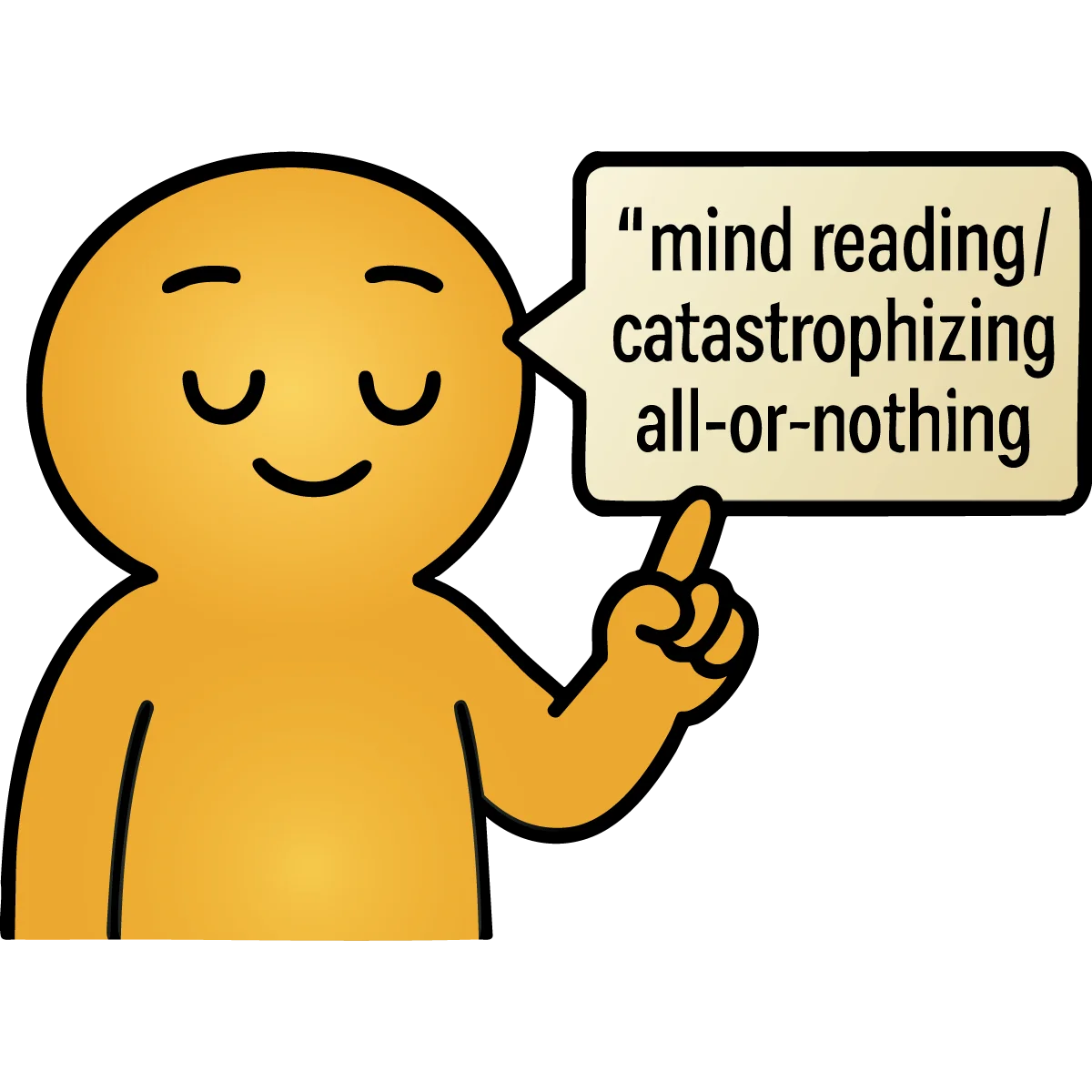
- Identify the pattern: You tell yourself, "Wait, this is 'mind reading' and 'catastrophizing'."
- Challenge the label: You acknowledge that you do not actually have proof they are mad at you.
- Let the Wise Owl lead: You decide they might just be busy, so you put your phone away and go for a walk.
By labelling the thought, your Wise Owl took charge. Your stress levels dropped and you avoided sending a reactive message.
Practice Tips
Try these ideas to help your Wise Owl get better at spotting the Guard Dog's barks before they get too loud.
- Breathe Through It
Try a slow breathing pattern while you label your thoughts to help your body feel safer and more relaxed.
- Keep a Thought Log
Write down the patterns you notice each day. This helps your brain get faster at recognizing them in the future.
- Start Small
Practice on small irritations, like being stuck in traffic, before trying it with your biggest fears.
Pro Tip
Why It Works
This skill is a great way to build resilience and keep your cool when things feel overwhelming.
This skill can help because:
- Builds Distance
It helps you see that you are not your thoughts, you are the person observing them.
- Calming System
It gives the emotional part of your brain a chance to settle down and stop the alarm.
- Better Choices
When you are not reacting to every loud thought, you can make choices that are better for your well-being.
References
Research-based evidence supporting this skill
- This technique is rooted in proven methods like Cognitive Behavioural Therapy and mindfulness, which help people manage stress by changing how they relate to their thoughts.
- Scientific Archives. (2022). Do diagnostic labels affect how symptoms of mental illness are perceived?
- PMC. (2022). Consequences of a diagnostic label: A systematic scoping review.
- PMC. (2017). Labelling effects and adolescent responses to peers with depression.
- Eggshell Therapy. (n.d.). In search of my 'label' - Rethinking diagnosis and identity.
- Thoits, P. A. (2024). Self-labeling and mental health service use.
- Psychology Today. (2022). How the 'mental illness' label helps and hurts.
- Help Therapy. (n.d.). To label ourselves with mental health disorders or not?
- YouTube. (n.d.). What's in a label? The struggle to define mental illness.