Leaves on a Stream
Key ideas
Skill summary
Three quick reminders before you start.
Overview
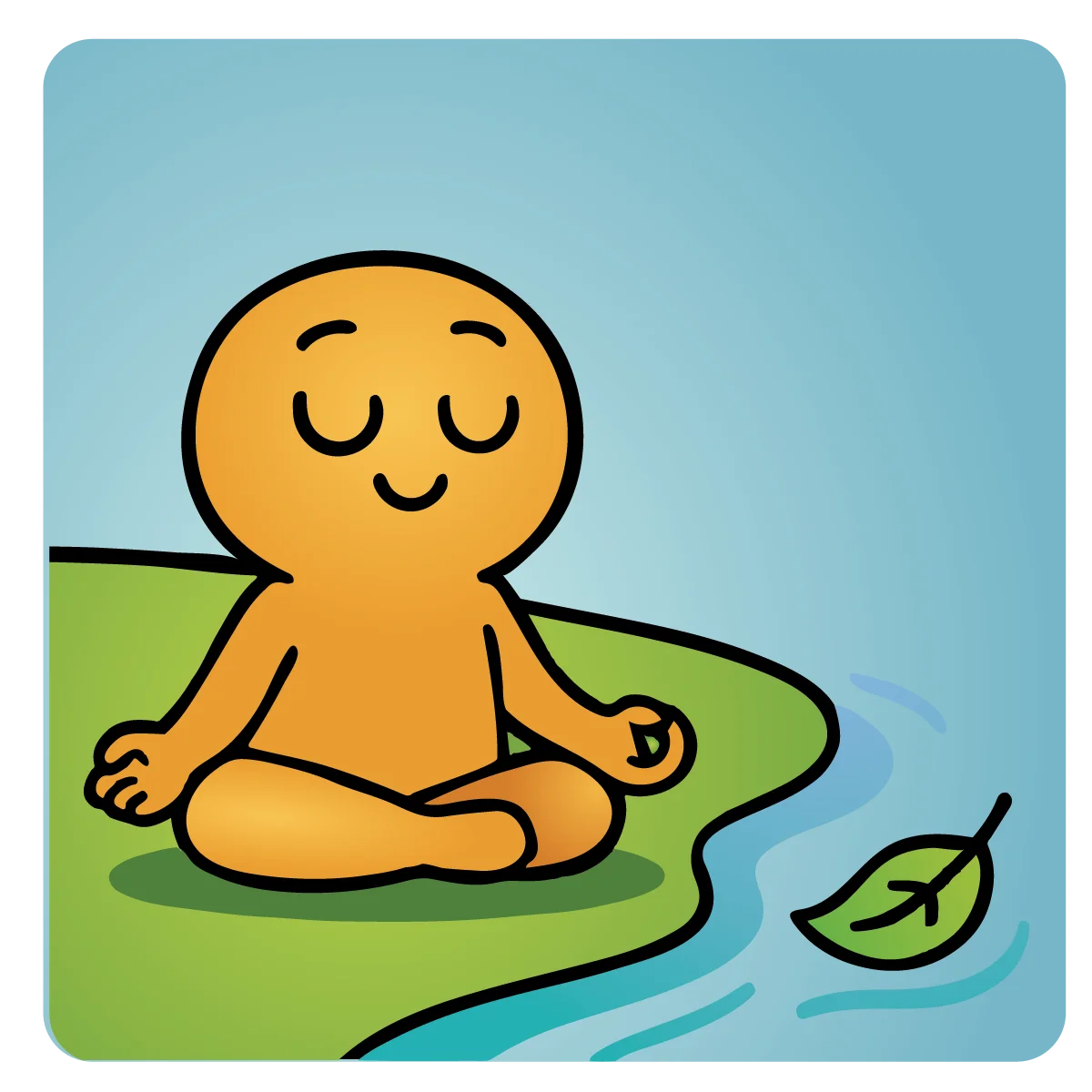
Ever feel like your brain is stuck on a loop? Leaves on a Stream is a simple way to look at your thoughts without getting swept away by them. Instead of fighting your thoughts or trying to hide them, you just notice them and let them pass by like objects in nature.
This tool helps you realize that you are not your thoughts. By creating a little bit of distance, you can decide how to act instead of just reacting to every feeling that pops up.
How Your Brain Works
Your brain uses two main parts to manage your feelings and your ability to think clearly.
The Guard Dog
The alarm system. Reacts to stress with fight-or-flight responses.
The Wise Owl
Logic and calm decision-making, best accessed when the alarm quiets down.
The Alarm
The Guard Dog (Amygdala) lives in the basement of your brain. Its only job is to look for trouble. When you have a scary or annoying thought, the Guard Dog starts barking loudly. It makes your heart race and makes you feel like the thought is a huge monster you have to fight right now. This is called fusion, where the thought and the person become stuck together.
The Shift
The Wise Owl (Prefrontal Cortex) lives in the upstairs part of your brain. This is the part of you that can pause, look at the big picture, and solve problems. When you use the Leaves on a Stream skill, you are inviting the Wise Owl to take the lead. Instead of getting into a fight with the Guard Dog, the Wise Owl just watches the barks pass by like leaves on water. This shift activates your brain's logic centre and helps you stay in the driver's seat of your own behaviour.
Building Strength
When you practice this, you are teaching your brain that thoughts are just bits of language and pictures. They are not always facts, and they do not have to control you. Over time, the Wise Owl gets much faster at calming the Guard Dog down. This rewires your habits so that stressful moments feel less like an emergency and more like something you can handle with a bit of patience.
How to Use This Skill
Imagine you are sitting on the bank of a peaceful, flowing river on a cool autumn day. This is the setting for your Wise Owl to work.
Picture the Scene
Close your eyes and see a slow river with colourful leaves floating on the surface. Just watch the water move for a moment.
Label and Place
If you think (I am going to fail), imagine writing those words on a leaf and setting it gently onto the moving water.
Let it Drift
Watch the leaf float around a bend in the river until it is gone. If the same thought comes back, just put it on a new leaf.
Stay Present
Do this for a few minutes, allowing the stream to carry whatever comes up, whether the thoughts are good, bad, or neutral.
Real-Life Example
The Quiz Crash
The Bad Grade
A student gets a math quiz back and sees a grade that is much lower than they expected.
The Guard Dog Bark
I am never going to graduate and I am not smart enough for this class.
The Wise Owl Move
- The student notices the Guard Dog is barking and takes a breath.
- They picture the stream in their mind's eye.
- They take the thought (I am not smart) and place it on a big maple leaf.
- They watch it float away without trying to argue with it.
- They do the same for the next thought about graduation.
- They wait until they feel their shoulders drop and their breathing slow down.
The student's distress drops from an 8 to a 3. The Wise Owl is now in charge, so they decide to email the teacher for a extra help instead of giving up.
Practice Tips
Like any physical skill, this takes a little bit of regular effort to get the best results.
- Bedtime Routine
Try this for 5 minutes before sleep to help quiet your brain and lower nighttime stress.
- The Wandering Label
If your mind wanders away from the river, just say (wandering) to yourself and gently come back to the water.
Pro Tip
Why It Works
This skill helps you stop fighting your own mind and start observing it, leading to more control over your actions.
This skill can support you because:
- Brain Balance
It helps the Wise Owl calm the Guard Dog so you can think clearly when you are stressed.
- Mental Flexibility
It teaches you that you can have a difficult thought without having to do what it says.
References
Research-based evidence supporting this skill
- This technique is part of Acceptance and Commitment Therapy (ACT) and is used to help people manage anxiety and heavy thoughts.
- The Wellness Society. (n.d.). ACT therapy techniques: The leaves on a stream cognitive defusion exercise.
- Journal of Alternative and Special Needs Healthcare. (n.d.). Leaves on a stream: The effectiveness of a mindfulness-based exercise.
- Dialectical Behavior Therapy. (n.d.). Leaves on a stream.
- Journal of Medical Internet Research. (2024). The immediate impact of app-based psychotherapeutic exercises.
- Contextual Consulting. (n.d.). Leaves on the stream exercise.
- Mindfulness Muse. (n.d.). Leaves on a stream cognitive defusion exercise.
- MindBodyGarden. (n.d.). Racing thoughts at night? Try this evidence-based exercise.
- Texas Tech University. (n.d.). Leaves on a stream | relaxation tools.
- Therapy in a Nutshell. (n.d.). Stop overthinking: Leaves on a stream ACT anxiety skill #30.