Two-Minute Courage
Key ideas
Skill summary
Three quick reminders before you start.
Overview
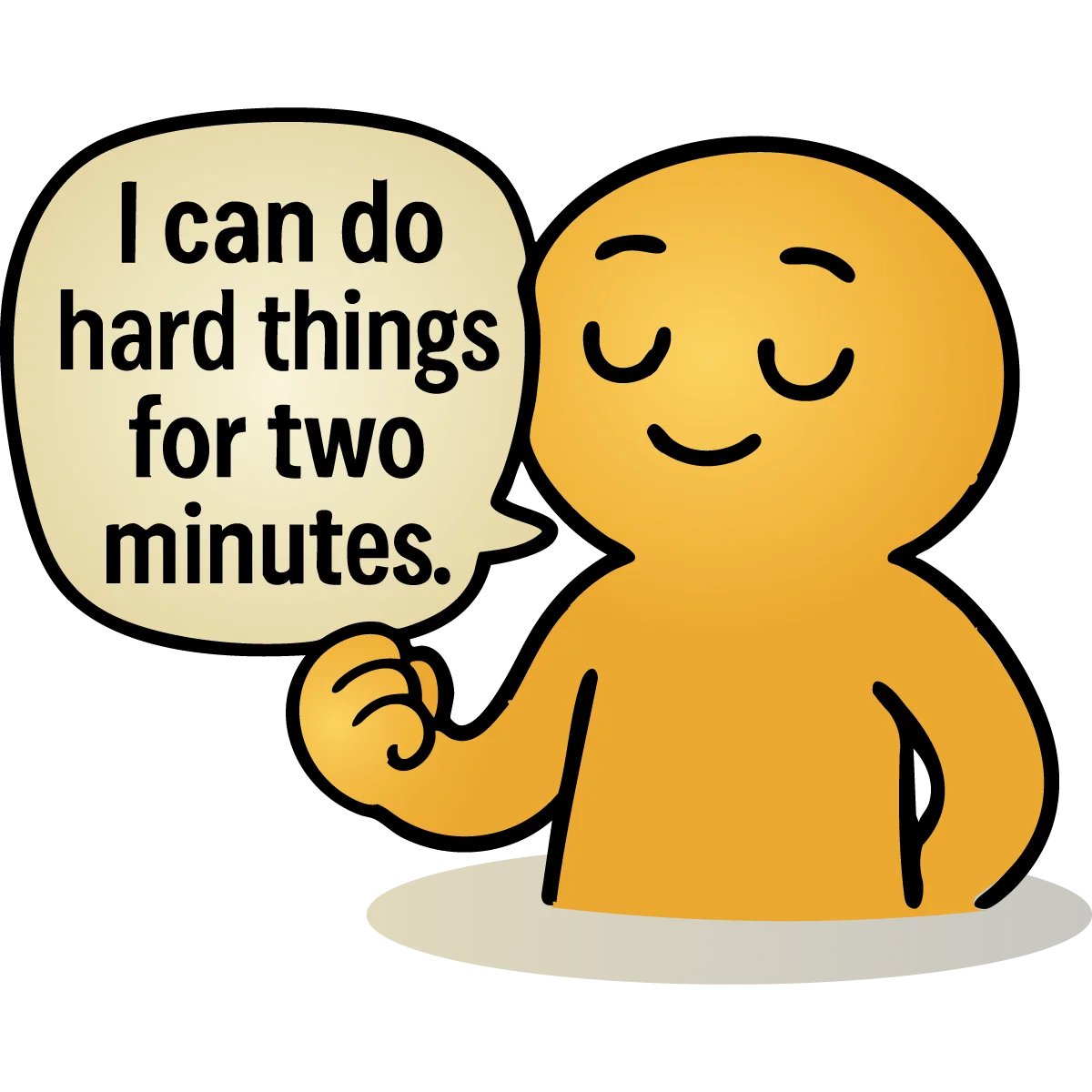
Two-Minute Courage is a method used to help overcome the hesitation we feel when starting a difficult or stressful activity. It involves making a small agreement with yourself to engage in the task for just two minutes. By setting a very short time limit, you make the prospect of starting feel much more manageable. This helps lower the pressure of a large project by focusing only on the first step.
How Your Brain Works
Your brain uses two main parts to manage your feelings and your ability to think clearly.
The Guard Dog
The alarm system. Reacts to stress with fight-or-flight responses.
The Wise Owl
Logic and calm decision-making, best accessed when the alarm quiets down.
The Guard Dog
Your brain has a built in alarm system called the Guard Dog. Its job is to keep you safe, but sometimes it barks at things that are not actually dangerous, like a big school project or a social situation. When it barks, it sends stress signals through your body, making your heart beat faster and giving you the urge to avoid the task to stay safe.
The Wise Owl
You also have the Wise Owl, which is the part of your brain responsible for logic and staying calm. The Wise Owl understands that while a task might feel scary, it is not a physical threat. When you use Two-Minute Courage, you are letting the Wise Owl take control. It tells the Guard Dog that you are only going to try the task for a very short time, which helps the Guard Dog feel less worried.
The Handshake
- Lowering the Alarm: Saying the phrase acts like a volume knob for the Guard Dog. It helps reduce stress chemicals in your system so you can think clearly.
- Building Confidence: Once you start, your brain releases chemicals that help with motivation. This makes it easier to keep going after the two minutes are up.
- Training the Brain: Each time you do this, you are teaching your Wise Owl to stay in charge. You are proving to yourself that you can handle tough moments without needing to run away. Over time, this behaviour makes you feel more capable.
How to Use This Skill
Think of this skill like a tiny experiment that helps your brain realize you are safe and capable.
Say the phrase: "I can do this for two minutes"
Look at the task that feels scary and say the words out loud or in your mind to set a clear boundary.
Begin the task immediately
If you need to write an essay, just open the laptop and type for two minutes without worrying if it is perfect.
Real-Life Example
Facing the Class Speech
The Nervous Heart
You are standing at the front of the classroom ready to give a presentation and your heart is racing.
The Guard Dog Barking
Your brain thinks: "This is going to be embarrassing and I cannot handle the pressure."
Applying the Skill
- Pause for a second and tell yourself, "I only need to do the first two minutes of this talk."
- Focus on your first three sentences and begin speaking.
- Notice how your breathing starts to even out as you get through the first minute.
- Realize that once you have started, the urge to run away begins to fade.
The Wise Owl takes the lead and the Guard Dog calms down as you realize you are handling the task just fine.
Practice Tips
Here are a few ways to help your brain get used to this new habit.
- Combine with calm breathing
Try taking slow breaths to help settle your Guard Dog while you use your two minutes of courage.
- Keep a success log
Write down every time you used this skill to help your Wise Owl remember how brave you are.
- Adjust the time
If two minutes feels like too much, consider starting with just thirty seconds to build your confidence.
Pro Tip
Why It Works
It is a low pressure way to build your confidence and help you face things that feel a bit scary.
This skill can help you because:
- Builds Bravery
It helps you practice taking action even when you feel nervous.
- Reduces Stress
It gives your brain a time limit so the internal alarm does not stay on for too long.
- Creates Habits
The more you do it, the easier it becomes for your calming system to stay in control.
References
Research-based evidence supporting this skill
- This technique is based on the idea that short bursts of action can help our brains get used to things we usually avoid, building bravery over time.
- Lidsen Publishing. (2024). Enhancing Therapist Courage: Feasibility and Changes in Distress.
- Howard, C. K., & Howard, J. R. (2010). Psychometric and behavioral evidence of the courage measure (CM).
- Bohannon, R. W., & Wang, Y. C. (2021). Reliability and Accuracy of 2-Minute Step Test in Active Adults. PubMed.
- Burton, C. M., & King, L. A. (2004). Effects of (very) brief writing on health: The two-minute miracle.
- Ribeiro, A. S., et al. (2022). Construct validity and reliability of the 2-Minute Step Test (2MST) in various populations. PubMed.
- Howard, C. K. (2020). Courage Measure (CM). Cross-Cultural Adaptation and Validation. Hogrefe.
- American Psychological Association. (2025). Courage: Why some people act despite fear. Monitor on Psychology.