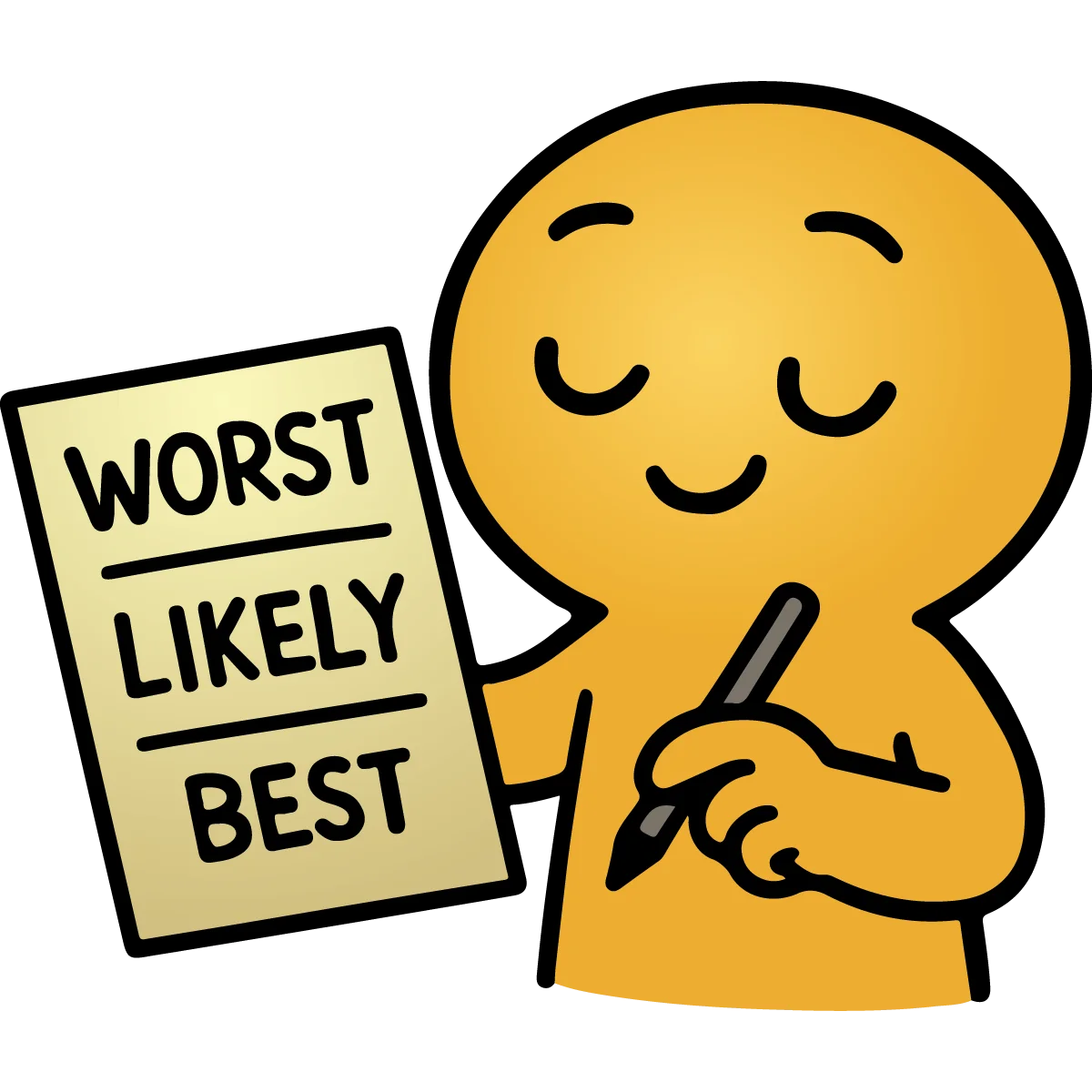
Worst → Likely → Best
Key ideas
Skill summary
Three quick reminders before you start.
Overview
This tool is a way to handle situations where your mind automatically jumps to the most negative result possible. By systematically looking at three different ways a situation could end, you can help your brain find a more balanced perspective. It is about checking your thoughts against real facts to see if they are accurate or just fueled by worry.
How Your Brain Works
Your brain uses two main parts to manage your feelings and your ability to think clearly.
The Guard Dog
The alarm system. Reacts to stress with fight-or-flight responses.
The Wise Owl
Logic and calm decision-making, best accessed when the alarm quiets down.
The Guard Dog's Alarm
When you feel anxious, your Guard Dog (the Amygdala) takes over. Its job is to keep you safe, but sometimes it gets way too loud. It fixates on scary scenarios and starts barking about the worst things possible. It floods your body with stress signals, making it hard to think clearly because it thinks you are in actual danger. This narrows your focus to survival mode, making everything feel like a huge threat.
The Wise Owl Steps In
The Wise Owl (the Prefrontal Cortex) is the part of your brain that thinks through problems, looks at facts, and makes calm decisions. When you use this tool, you are basically waking up the Wise Owl to help manage the situation. It helps to look at the evidence rather than just reacting to the noise from the alarm centre.
Creating a Shift
- Labelling the Fear: By naming the worst case, you help the Wise Owl label the fear, which helps the Guard Dog settle down.
- Building Perspective: Looking at the most likely case gives the Wise Owl evidence to work with, showing that the scary thing is unlikely.
- Opening Up: Thinking of the best case reminds your brain that positive outcomes are possible, helping you feel more motivated.
How to Use This Skill
Think of this tool as a way to help your internal team communicate better. It lets your Wise Owl take a moment to look at the facts before the Guard Dog's alarm gets too loud.
Name the Big Fear (Worst Case)
You might write down, 'I am going to trip on stage and everyone will think I am a total failure.'
Find the Middle Ground (Most Likely)
You realize that you might stumble on one word, but you will probably just keep going and finish the presentation fine.
Imagine the Win (Best Case)
You might imagine the audience clapping and feeling really proud of yourself after you finish the work.
Real-Life Example
The Audition Anxiety
The Worry
A teenager is getting ready for a school play audition and is worried about forgetting their lines.
The Guard Dog Thought
I am going to freeze up, everyone will laugh at me, and I will never be able to act again.
- Worst Case: The Guard Dog says I will freeze, get booed, and my reputation will be ruined forever.
- Most Likely: The Wise Owl points out that I might stumble on a line, but I can recover. I might not get the lead, but I will get a part.
- Best Case: I nail every single line and the director is totally impressed by my performance.
By looking at the likely outcome, the teen feels more calm. The Guard Dog stops barking because the Wise Owl shows that a mistake is not a disaster.
Practice Tips
Here are a few ways to make this habit stick so your Wise Owl stays sharp and ready to help.
- Put it on paper
Writing down your thoughts helps your Wise Owl see them clearly rather than letting them spin around in your head.
- Score the chance
Give each outcome a percentage from 0 to 100. You will often notice the scary one is very unlikely to happen.
- Try it daily
Practising this with small worries makes it easier to use when a big worry pops up.
Pro Tip
Why It Works
It helps you stop overestimating danger and starts building your brain's ability to stay flexible during stress.
This skill helps because:
- Balanced Perspective
It moves your mind away from only seeing the bad stuff and helps you see the whole picture of a situation.
- Calmer Reaction
By checking the facts, you help your body's alarm system stay quiet instead of staying on high alert.
- Better Focus
When you are not stuck on a scary loop, you have more energy to focus on what you actually need to do.
References
Research-based evidence supporting this skill
- This technique is rooted in Cognitive Behavioural Therapy and focuses on decatastrophizing. It helps the brain move from emotional reactivity to logical evaluation.
- Talk with Wayfinder. (2023). Worst, Best, and Most Likely Case - Anxiety Skill Building. Retrieved from
- Positive Psychology. (2023). Catastrophizing and Decatastrophizing: A Comprehensive Guide. Retrieved from
- Cognitive Science Society. (2020). What is an extreme outcome in risky choice? Retrieved from
- Wikipedia. (2023). Best–worst scaling. Retrieved from
- The Decision Lab. (2023). Dunning–Kruger Effect. Retrieved from
- PubMed Central. (2020). The Worst Performance Rule, or the Not-Best. Retrieved from
- Simply Psychology. (2023). Reliability vs Validity in Research. Retrieved from